Key takeaways
- FDA allows cosmetics to be made at home, but you are responsible for their safety.2
- Claims decide the category. "Moisturizes" is a cosmetic claim; "treats eczema" makes it a drug.1
- Businesses averaging under $1 million a year in US cosmetic sales are exempt from MoCRA registration and listing, with exceptions.5
- True soap is regulated by CPSC, not FDA, as long as you make no cosmetic claims.1
- Guild-backed product liability insurance starts at $290 a year, plus a $250 membership.89
Who should start a skincare line?
A skincare line suits someone who reads labels for fun. You will weigh ingredients to the gram, keep batch records and think hard about every word on the jar.
It is a crowded shelf. The small brands that last tend to do one thing well, like a single balm, and build a loyal group of buyers around it.
- Good fit: you are careful, you like simple formulas and you enjoy explaining ingredients.
- Poor fit: you want to promise results like clearer skin or fewer wrinkles. Those are drug claims.
- Related guides: the pouring and labeling work is close to a candle business. If you prefer food, read about a home bakery.
How do you start a skincare line, step by step?
Start with anhydrous products
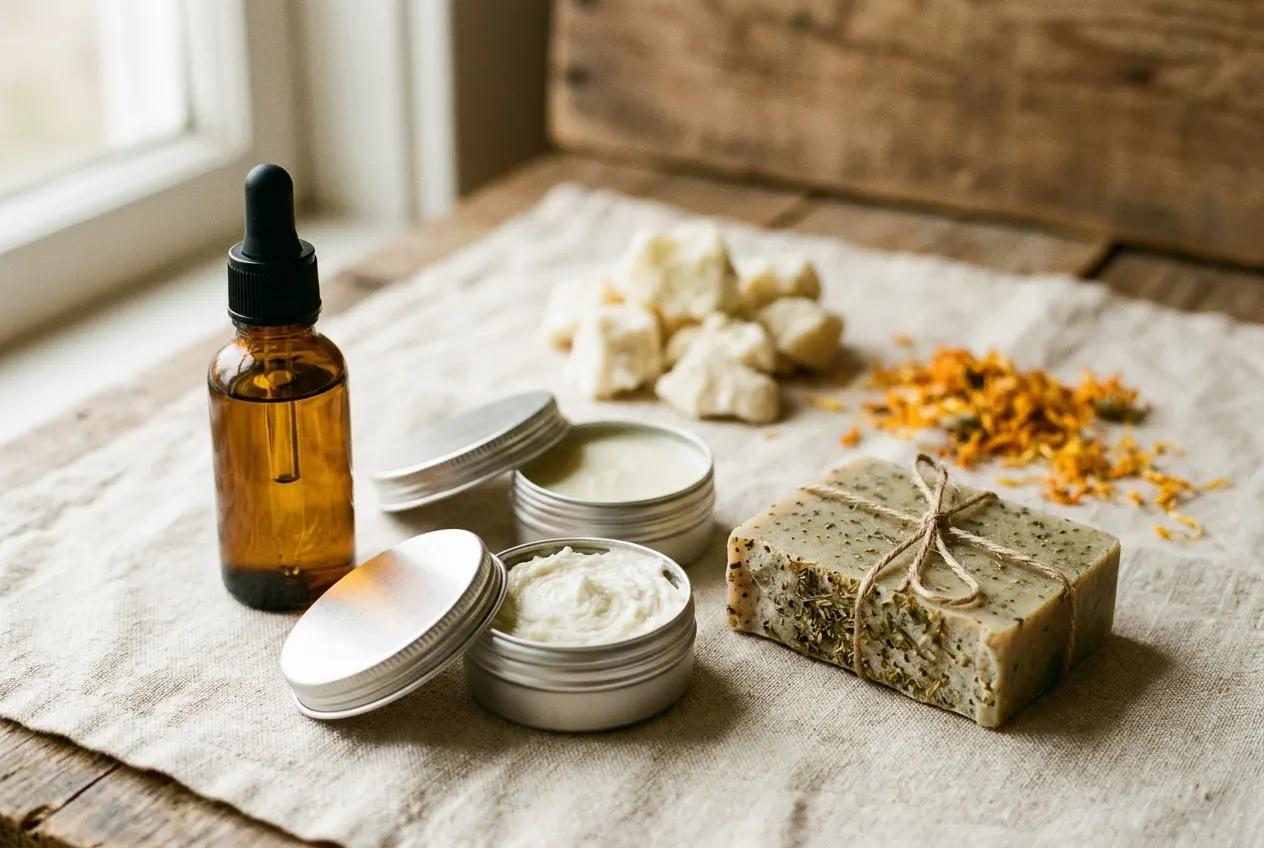
Balms, butters and oils contain no water, so they are simpler to keep stable than lotions. Lotions need preservatives and more testing.
Decide what you will claim
FDA treats a product meant to cleanse or beautify as a cosmetic. A product meant to treat a disease or change how the body works is a drug.1 Write your product copy before your formula, then keep it cosmetic.
Make small batches and keep records
Weigh everything, number every batch and keep a sample. FDA says homemade cosmetics are legal, but the maker must make sure they are safe.2
Get insured
Product liability cover matters when people put your product on their skin. The Handcrafted Soap & Cosmetic Guild sells $1 million per-occurrence cover from $290 a year to Professional members.8
Launch with one hero product
Sell one product in two or three sizes. Learn what buyers say, then add the next item.
How much does it cost to start a skincare line?
Ingredients and containers are cheap. Insurance is often the biggest line in year one.
| Item | What you get | Price |
|---|---|---|
| Organic unrefined shea butter | 8 bags of 8 oz at $17.256 | $138.00 |
| 2 oz deep tins with slip covers | Case of 432, about $0.58 each7 | $248.99 |
| HSCG Professional membership | Required for the guild's insurance9 | $250.00 |
| Handmade Minimal insurance | $1M per occurrence, one year8 | $290.00 |
| Shopify Basic, first month | Online store12 | $39.00 |
| Total | $965.99 |
What does one tin cost to make?
| Input | Math | Cost |
|---|---|---|
| Shea butter | 1.6 oz at $2.16 per oz | $3.45 |
| Tin | 1 of 432 at $248.99 | $0.58 |
| Materials | $4.03 |
How do you sell skincare online?
Skincare buyers want to know exactly what is inside. Put the full ingredient list on every product page, not just the label. Show the texture with a close photo or a short video.
Reviews matter here more than in most categories. Ask early buyers for honest feedback and fix formulas before you scale. Never post reviews that make medical claims on your behalf.
What mistakes do new skincare makers make?
- Making drug claims. "Heals," "cures" and "treats" change how FDA sees your product.
- Starting with water-based lotions. They need preservatives and testing that balms do not.
- Skipping batch records. Without them you cannot trace a complaint.
- Using a P.O. box on the label. FDA requires a real address.
- Launching ten products. One great balm beats a thin range.
If you are unsure about skincare as a first business, compare it with making dog treats, which has its own label rules, or browse all business ideas by skill.
Skincare line FAQ
Do I need FDA approval to sell skincare?
No. FDA does not approve cosmetics before sale. You are responsible for making sure products are safe and correctly labeled. Products that make drug claims follow drug rules instead.
Can I make skincare products at home and sell them?
Yes. FDA's fact sheet for homemade cosmetics says it is not against the law to make cosmetics at home. They must be safe and properly labeled with your name and full address. State and local rules may also apply.
Does MoCRA apply to small skincare brands?
MoCRA requires facility registration and product listing, but small businesses averaging under $1 million a year in US cosmetic sales over three years are exempt from those rules and from GMP requirements. Some products, such as those used near the eyes, are not covered by the exemption.
How much does insurance cost for a handmade skincare business?
The Handcrafted Soap & Cosmetic Guild lists Handmade Minimal cover at $290 a year and Handmade Standard at $395, each with $1 million per occurrence. You also need its Professional membership, which is $250 a year.
Sources
Prices and rules checked on November 19, 2026. Prices change; confirm before you buy.
- 1.U.S. Food and Drug Administration. Is It a Cosmetic, a Drug, or Both? (Or Is It Soap?)
- 2.U.S. Food and Drug Administration. Small Businesses & Homemade Cosmetics: Fact Sheet
- 3.U.S. Food and Drug Administration. Summary of Cosmetics Labeling Requirements
- 4.U.S. Food and Drug Administration. Modernization of Cosmetics Regulation Act of 2022 (MoCRA)
- 5.U.S. Food and Drug Administration. Guidance: Registration and Listing of Cosmetic Product Facilities and Products
- 6.Mountain Rose Herbs. Unrefined Shea Butter
- 7.WebstaurantStore. 2 oz. Silver Deep Tin with Slip Cover, 432/Case
- 8.Handcrafted Soap & Cosmetic Guild. Insurance FAQ
- 9.Handcrafted Soap & Cosmetic Guild. About Membership
- 10.Encyclopedia.com. Burt's Bees, Inc.
- 11.Beautylish. Herbivore Botanicals co-founder interview
- 12.Shopify. Pricing
- 13.Etsy Help Center. Etsy Fee Basics
- 14.Etsy Help Center. What are Payment Processing Fees for Selling on Etsy?